
A One-Day Urban Sketching Route Through Bologna's Backstreets
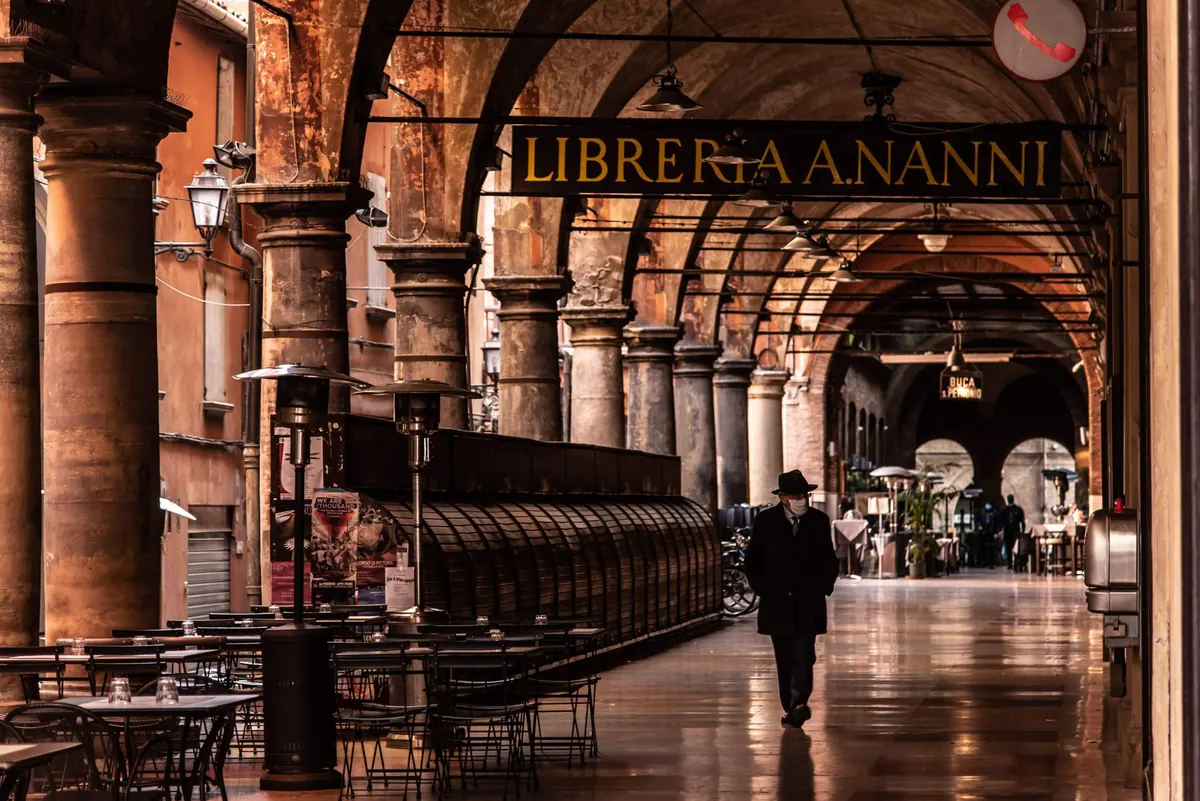
Piazza Maggiore is where everyone starts, which is exactly why you should not stay there. Bologna's real drawing material is one street back: the fish-market alley where crates are stacked against medieval stone, a crack in a wall with a canal glinting below it, a courtyard that swallows the city's noise in three steps. This route strings those places together into a single walking day — roughly six kilometres with stops, entirely flat, most of it under porticoes. One sketchbook, one pen, a small watercolour set, and the willingness to draw standing up when a doorway gets busy. That is the whole kit list.
8:00–9:30 — The Quadrilatero before the shutters go up
Start at the mouth of Via Pescherie Vecchie, off the western edge of Piazza Maggiore, and walk north into the market grid: Via Drapperie, Via Caprarie, Vicolo Ranocchi, Via Clavature. At eight in the morning the deliveries are still happening. Crates of clams sit on wet stone, a man is hosing down a step, and the shop awnings are being cranked out one by one. By eleven this same alley will be shoulder to shoulder with shoppers, so draw it now.
The light down here is mostly bounce, not sun, which is a gift: no hard shadows to chase, just soft verticals. Stand at the corner of Via Drapperie where it opens onto the square and take the one-point perspective straight down the street. The vanishing point is barely twenty metres away, the strip of sky above is thin, and the whole thing fits on an A5 page in about twenty-five minutes.
Keep clear of shop doorways — this is unloading hour and you will be in the way. Tuck yourself into a recess, brace the book against your forearm, and work small. Two drawings here is plenty; the route is long and the morning light moves.
9:45–11:00 — Via Piella and the canal window
Head north, five minutes or so from the Quadrilatero, and find Via Piella. Halfway along there is a small opening in the wall — the finestrella — and through it, absurdly, a canal. The Canale delle Moline runs below street level here, green-walled and quiet, with water moving between buildings that seem to have grown over it by accident.
There is usually a small cluster of people at the window, phones raised. Sketch from a step or two back and to the side instead; you get the same view plus the silhouettes of the onlookers, which are more interesting than the canal alone. Draw the frame first — the aperture, the ledge, the edge of the wall — then place the water and the moss line inside it. Fifteen minutes, no colour, and you have the most recognisable page of your day.
If the window is blocked, walk on and look for the canal's other glimpses between buildings. The sound of running water is a good guide.
11:15–13:00 — West to Via del Pratello
Cross back through the centre, take Via Ugo Bassi west, and peel off into Via del Pratello and the small streets that hang off it — Via de' Gombruti, Via dell'Inferno, Via del Borgo. This is a different Bologna: lower buildings, graffiti on the shutters, bicycles chained three deep to anything vertical, laundry strung above a courtyard, an osteria with its chairs still stacked.
Draw a single shutter panel close up. Ten minutes on the corrugation, the tags, the rust creeping from the hinge, and you will have learned more about how to render texture than an hour of careful architecture. Then step back and draw the whole facade — door, shutter, window, drainpipe — as a flat elevation, like a survey. The two drawings together make a good spread.
This is also a sensible place to eat: a bakery slice, a plate of tortellini at a table outside. Keep the sketchbook open while you wait. Half-finished drawings of shopfronts, done while someone brings you water, are often the loosest and best pages of a trip.
14:00–15:45 — Corte Isolani and the triangular square
Walk east toward the Two Towers and the head of Via Santo Stefano. Before the basilica, duck into Corte Isolani, the porticoed courtyard that links Strada Maggiore with Via Santo Stefano. It is a short cut, but it is also a box of columns and shadow that empties of people in waves. Sit on a step and draw the rhythm of the arcade: column, gap, column, gap. This is a warm-up, not a masterpiece — twelve minutes, a soft pencil, no erasing.
Then out to Piazza Santo Stefano, which is not really a square but a triangle widening away from you, with the basilica complex at the far end. Draw the ground plane first, in perspective, before a single building. Get that triangle right and everything else can be approximate; get it wrong and no amount of detail will save the page. Add one figure standing near the portico — just a vertical stroke and a shadow blob — and the square will read as a place rather than a diagram.
16:00–17:15 — The university porticoes
Return to Piazza di Porta Ravegnana, where the two towers lean over the crossroads, and walk north up Via Zamboni. This is the student spine: porticoes on the left, a long colonnade ahead, and by mid-afternoon a low sun cutting bands of light across the pavement between the columns.
Consider one of the two towers from directly below — a tight, uncomfortable angle that makes the lean obvious and gives you a dramatic, oddly cropped drawing. Or sit on the steps near Piazza Verdi and draw the colonnade in elevation, using the shadow pattern on the floor to establish the depth. Bands of light are easier to draw than columns, and they carry the eye into the page.
If you still have energy, push up into Via Mascarella or Via delle Belle Arti for a quieter street of bicycles, doorbells and second-hand shops.
Compact prompts to keep in your pocket
- Threshold study — one doorway, one step, one crate. Ten minutes.
- Window frame — draw the aperture first, fill it last. Fifteen minutes.
- Shutter panel — texture only, no perspective. Ten minutes.
- Arcade rhythm — three columns, the gaps between them, nothing else. Twelve minutes.
- Ground plane — the paving of a square in perspective, buildings added only if time allows. Fifteen minutes.
- One figure, one shadow — a passer-by, remembered rather than studied. Two minutes.
- Sky strip — the sliver of sky between two roofs, plus the cornices framing it. Eight minutes.
- Sound drawing — work for ten minutes without looking up except to check a single vertical, and see what you remember.
Finishing well: light, feet, and the last hour
Between 17:30 and 19:00 the light gets long and orange on Bologna's plaster, and the porticoes start throwing warm reflections onto their own ceilings. Use that last hour for a wide view rather than another detail: stand at the edge of a small square and draw the whole silhouette, roofline to paving, in one go. It is a good way to close a day of close looking.
A few practical notes. The route is short — every stop is within twenty minutes' walk of the next — so if a place does not work, leave it; you have alternatives behind you. Porticoes give you shade and, when it rains, shelter for the whole day. Carry water, and remember that churches are quiet places: sketch from a bench, keep the book low, and step out if a service begins. In shops, ask before drawing the interior; in courtyards, keep to the edges and do not block a passage. And leave the last stop loose. Bologna's backstreets reward the sketcher who sits down for ten unplanned minutes, and the route is only there to put you in the right place at the right hour.